
The AI-Augmented DBA Team: Mentoring and Knowledge Transfer
Most of this series has focused on individual DBA productivity - you and an AI agent getting things done faster. This post is about the team-level effects: how AI agents change mentoring, knowledge transfer, and the role of the senior DBA.
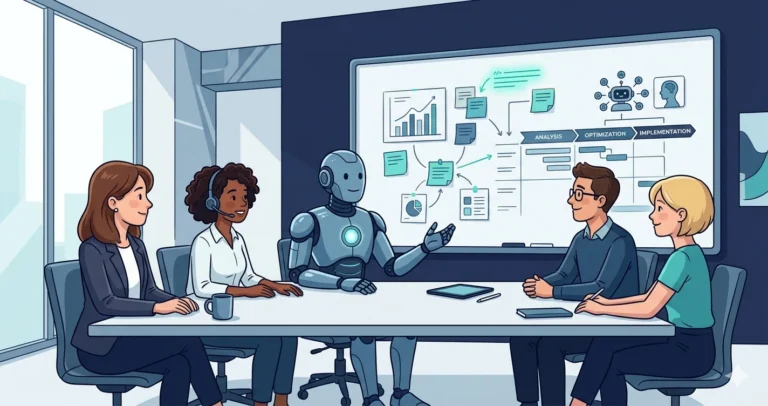
The Knowledge Transfer Problem
Every DBA team has the same structural issue: critical knowledge lives in a few people’s heads. The senior DBA knows why that one stored procedure has a seemingly unnecessary temp table (it prevents a parameter sniffing issue that crashed the order entry system in 2019). The most experienced team member knows which indexes on the reporting server were added after a specific vendor patch and can’t be removed without breaking the ETL.
This tribal knowledge is the most valuable thing on the team - and the most fragile. When the senior DBA goes on vacation, retires, or gets hit by the proverbial bus, that knowledge disappears.
AI agents don’t solve this problem directly. But they change how knowledge gets documented, shared, and applied - in ways that matter.
The Agent as a Learning Tool
One of the most underappreciated uses of AI agents is for learning. Not “learning AI” - learning SQL Server.
When a junior DBA asks the agent to explain a blocking chain, the agent provides candidate explanations: which DMVs to check, how to trace lock ownership, what the wait types mean, why PAGEIOLATCH_SH is different from PAGEIOLATCH_EX. That reasoning process mirrors what a senior DBA would teach - except the agent is available at 2 AM and never gets impatient.
But it’s also sometimes wrong. The agent gives plausible-sounding explanations that don’t hold up against actual DMV output. At 2 AM, a junior DBA may not know the difference. The right pattern is: use the agent to generate hypotheses, then validate against DMVs, runbooks, and senior review before acting.
This doesn’t replace mentoring. A junior DBA who only learns from AI risks building confidence without depth - producing scripts without understanding locking, recovery models, cardinality, or rollback risk. Teams need “AI-off” fundamentals training where juniors explain their reasoning, not just their output. The agent handles the “explain the mechanics” tier of learning; the senior DBA focuses on the judgment and context tier.
Try This Yourself: Ask a junior team member to work through a performance issue with the agent while you observe. Watch what the agent explains well and where it leads them astray. That gap is exactly where your mentoring should focus.
AI-Assisted Code Review
Code review is where senior DBA time is most leveraged - and most bottlenecked. Every stored procedure change, every index modification, every deployment script goes through the senior DBA’s queue. The queue is always too long.
An AI agent won’t replace the senior reviewer. But it can be a very effective first-pass reviewer - and Post 16 covers PR review workflows in depth. The short version:
|
1 2 3 4 5 6 7 |
Review this stored procedure for: 1. SQL injection vulnerabilities (dynamic SQL, string concatenation) 2. Missing error handling (no TRY/CATCH, no XACT_ABORT) 3. Performance concerns (implicit conversions, missing SARGability, table scans on large tables) 4. Standards violations per our copilot-instructions.md 5. Missing transaction management |
The agent catches the mechanical issues - missing semicolons, implicit conversions, unparameterized dynamic SQL, standards violations - and flags known anti-patterns. It’s good at checklist-style review and static analysis. It’s weak at workload-specific performance assessment and operational safety - those require schema context, row counts, execution plans, and deployment knowledge that static code alone can’t provide.
The senior DBA still reviews every production-impacting change. But the AI first pass means the senior’s time gets spent on the problems that require experience and judgment, not on catching missing semicolons.
Building Runbooks That Stay Current
Every DBA team has runbooks. Every DBA team’s runbooks are out of date.
The problem isn’t writing runbooks - it’s maintaining them. When the AG topology changes, when backup procedures are updated, when monitoring tools get replaced, the runbooks fall behind. Nobody has time to update documentation as a primary task.
AI agents change this dynamic in two ways:
Generation: When you solve a problem with the agent’s help, the conversation itself becomes a draft runbook. Ask the agent to format the resolution into runbook steps before you close the session:
|
1 2 3 4 5 6 7 |
Take the resolution we just worked through for the blocking incident and format it as a runbook. Include: 1. Symptoms that trigger this runbook 2. Diagnostic steps with the actual queries we used 3. Resolution steps with safety checks 4. Escalation criteria 5. Post-resolution verification |
Updates: When a runbook step no longer matches reality, paste the runbook and the current state into the agent:
|
1 2 3 4 5 |
Here's our AG failover runbook. We recently added a fourth replica as an async DR node. Update the runbook to include: 1. The async replica in the pre-flight checks 2. Any differences in the failover procedure 3. Updated validation queries |
The agent generates an updated runbook that you review and publish. The delta between “out-of-date runbook” and “current runbook” goes from a half-day project to a thirty-minute review. But lowering the drafting cost doesn’t solve the ownership problem - you still need a named owner, a review cadence, and a “last validated” date on every runbook. AI makes documentation cheaper to produce and update. It doesn’t make documentation maintain itself.
The Senior DBA’s New Role
Here’s the career implication that most discussions of AI miss: the senior DBA’s value doesn’t decrease with AI agents. It shifts.
Before AI agents: The senior DBA’s value was partly knowledge (they know the DMVs, the syntax, the edge cases) and partly judgment (they know which issues matter, which fixes are safe, which changes need more testing).
With AI agents: The knowledge-recall component becomes less differentiating - the agent knows the DMVs too. But the judgment component becomes more valuable: incident leadership, risk assessment, stakeholder communication, deployment sequencing, and accountability. These are the things that separate a senior DBA from a junior with good tooling, and AI doesn’t change that.
The senior DBA becomes less of an oracle (the person with the answer) and more of a curator and editor:
- Curator of AI context: building and maintaining the custom instructions, knowledge bases, and schema documentation that make the agent effective (Post 15)
- Editor of AI output: reviewing the agent’s suggestions against production reality - catching the cases where technically correct isn’t operationally safe
- Mentor of judgment: teaching junior DBAs when to trust the agent and when to question it - which is really teaching them the judgment that separates a junior from a senior
Building a Team Knowledge Base
The previous post covered custom instructions for individual productivity. For a team, the approach extends to a shared knowledge base:
- Shared repository instructions (
.github/copilot-instructions.md) encode team standards that every team member’s agent follows - Documented common scenarios in a team wiki or repository that agents can reference - “how we handle failovers,” “our deployment checklist,” “our escalation matrix”
- Post-mortem summaries from incidents, formatted so agents can learn from past issues: “when we see this wait pattern, check these three things first”
The goal isn’t to build a comprehensive AI training dataset. It’s to capture the decisions and context that usually live in people’s heads and make them available to both human team members and AI agents.
Adoption Friction
In real teams, AI adoption is uneven. One senior embraces it immediately, one refuses to trust it, one uses it badly and deploys unreviewed output, and management starts expecting more throughput before the team has figured out good practices.
Some practical guidance for team leads:
- Start with one use case - first-pass review of deployment scripts is a good one
- Run in shadow mode for a few weeks - have the agent review the same scripts the senior reviews, and compare what each catches
- Require human sign-off on all production-impacting changes, regardless of AI involvement
- Create a simple team policy: what data can be pasted into the agent (no customer data, no credentials, no unredacted server names), what requires human verification, and what’s explicitly prohibited
- Track outcomes - review turnaround time, false positives, incidents caused by missed issues
The teams that adopt AI well are the ones that treat it as a tool with clear boundaries, not as a replacement for process.
The Career Conversation
Let’s be honest about career implications rather than glossing over them.
AI agents will probably compress some routine DBA work. That may mean fewer entry-level positions focused purely on script writing and basic monitoring. It will likely raise the bar for what’s expected of individual DBAs - more output, broader scope, faster turnaround.
But strong DBAs who combine solid fundamentals with good judgment become more valuable in this environment, not less. The demand for people who can evaluate AI output against production reality, make risk decisions under pressure, and communicate technical constraints to non-technical stakeholders isn’t going away. If anything, it increases as AI makes it easier for non-DBAs to propose database changes that seem reasonable but aren’t.
The risk isn’t obsolescence - it’s complacency. DBAs who coast on accumulated knowledge without adapting their workflow will find the gap between them and AI-augmented juniors narrowing faster than they expect.
Next up: How This Series Was Written: A DBA and an AI Walk Into a Terminal - the meta post. Full transparency about how this entire series was planned, drafted, and refined using the AI agents it describes.
Part of the ALTER DBA ADD AGENT series - Previous: PR Reviews