
The Case for Business Logic in Application Layers
This is the third post in the “Where Does Business Logic Live?” series, and it is the deliberate mirror image of the last one. In Part 2 I made the strongest case I could for putting data-centric business logic in stored procedures. Now I am going to argue the other side just as seriously: why a great deal of business logic belongs up in the application layers - the n-tier service, the microservice, the REST API - and sometimes even out at the edge in the browser.
I am still a DBA writing this. But I have supported enough systems to know that the application-tier argument is not a fashion, and it is not developers being lazy about SQL. There are real, structural reasons the industry moved logic upward, and pretending otherwise is how DBAs end up shouting into the wind while the architecture decisions get made without them.
There is also one argument in this space that gets played as a trump card and should not be, so I am going to deal with it head-on partway through: the claim that the application tier deserves the logic because “that is where CI/CD lives.” That claim is half right and half a misunderstanding, and untangling it is one of the more useful things in this post.
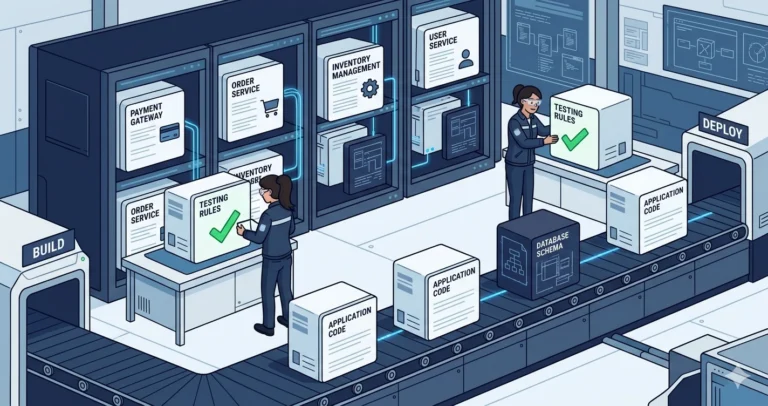
Separation of Concerns: The Business in the Language of the Business
The foundational argument for the application tier is separation of concerns. Storage is one concern. Expressing how the business behaves is another. Mixing them - encoding a complex, branching business process in the same place you store rows - couples two things that change for different reasons and at different rates.
Application code lets you model the domain in a general-purpose language with first-class support for the things complex logic needs: rich types, polymorphism, composition, dependency injection, design patterns, and a module system. Martin Fowler’s Domain Model pattern is the canonical articulation of this - business behavior lives on objects that represent the domain, in the language the developers work in all day.[1] For logic with a lot of conditional branching, state, and rules that interact, a real programming language is simply a better tool than T-SQL. This is not controversial even among database people: nobody wants to write a multi-step approval workflow with seven decision points as a 2,000-line stored procedure.
The “where should business logic go?” question has been asked thousands of times by application developers for exactly this reason, and the consistent answer in those discussions is that the domain logic wants to live in a dedicated layer, separate from both the database and the UI.[2]
A worked example in ASP.NET Core: a domain service that owns a business rule, with the database accessed through a repository abstraction.
|
1 2 3 4 5 6 7 8 9 10 11 12 13 14 15 16 17 18 19 20 21 22 23 24 25 26 |
public sealed class OrderService { private readonly IOrderRepository _orders; private readonly ICustomerRepository _customers; public OrderService(IOrderRepository orders, ICustomerRepository customers) { _orders = orders; _customers = customers; } public async Task<OrderResult> PlaceOrderAsync(PlaceOrderCommand cmd) { var customer = await _customers.GetByIdAsync(cmd.CustomerId); if (customer is null) return OrderResult.Rejected("Unknown customer."); // Business rule lives here, in the domain language. if (customer.AvailableCredit < cmd.Total) return OrderResult.Rejected("Order exceeds available credit."); var order = customer.PlaceOrder(cmd.Lines); // behavior on the domain object await _orders.AddAsync(order); return OrderResult.Accepted(order.Id); } } |
The rule “an order cannot exceed available credit” is expressed once, in the domain, testable in isolation, readable by anyone who knows C#. That is the separation-of-concerns payoff.
A caution worth stating, because it is the most common way this goes wrong: when all the behavior drains out of the domain objects and into procedural service methods, leaving the objects as nothing but bags of getters and setters, you have built what Fowler calls an Anemic Domain Model - an anti-pattern that gets you the cost of a domain model with few of its benefits.[3] Moving logic to the application tier is only a win if the application tier actually models the domain well. Done badly, it is just a stored-procedure monolith rewritten in a slower language.
Testability and Automated Testing
This is, for many teams, the single most persuasive advantage, and it is a fair one.
Logic in application code can be unit tested in milliseconds, in memory, with no database in the loop. You instantiate the service, hand it test doubles for its dependencies, call the method, and assert on the result. Thousands of these run in seconds on every commit.
|
1 2 3 4 5 6 7 8 9 10 11 12 13 |
[Fact] public async Task PlaceOrder_Rejects_When_Over_Credit_Limit() { var customers = new FakeCustomerRepository( new Customer(id: 1, availableCredit: 100m)); var service = new OrderService(new FakeOrderRepository(), customers); var result = await service.PlaceOrderAsync( new PlaceOrderCommand(CustomerId: 1, Total: 150m)); Assert.False(result.Accepted); Assert.Equal("Order exceeds available credit.", result.Reason); } |
Testing the equivalent logic in a stored procedure is genuinely harder. There are frameworks for it - tSQLt is the established one for SQL Server - but they require a database instance, the tests run slower, and the tooling and culture around them are far less mature than what application developers take for granted. When a team’s confidence to change code comes from a fast, comprehensive test suite, logic that cannot easily join that suite feels risky to own. That is a legitimate driver, not a prejudice.
I will register one honest counterpoint and move on: “easy to unit test” and “behaves correctly against real data at scale” are not the same property. A rule that passes ten thousand in-memory unit tests can still generate a catastrophic query plan against a billion-row table. The application tier’s testability advantage is real for correctness of logic; it does nothing for behavior of the data access, which still has to be verified against a real database. Hold that thought - it is the heart of Part 4.
CI/CD - And Why It Is Not an Application-Only Privilege
Here is the argument I want to defuse. It usually goes: “Business logic should live in the application because that is where modern engineering practice lives - version control, pull requests, automated builds, continuous integration, continuous deployment. The database is a deployment bottleneck, so keep logic out of it.”
The first half is a real benefit. The second half is a false inference, and DBAs should stop letting it slide.
It is true that application code drops naturally into a CI/CD pipeline: commit, build, test, deploy, with the whole history in source control and every change gated by review. That discipline is enormously valuable, and historically a lot of database code did not get it - schema changes applied by hand, procedures edited live in production, no review, no history. That was a genuine problem.
But the conclusion is not “therefore move logic out of the database.” The conclusion is “therefore put the database under the same discipline.” Database code - tables, constraints, indexes, views, functions, and yes, stored procedures - belongs in source control and a deployment pipeline exactly like application code does. The tooling to do this is mature and has been for years:
- State-based: SSDT /
.sqlprojprojects build a DACPAC, andsqlpackagediffs it against the target and generates the deployment script. The database schema is declarative, versioned, and deployed by a pipeline. - Migration-based: Flyway, Liquibase, DbUp, and Redgate’s tooling version every change as an ordered, repeatable migration that the pipeline applies and validates. Flyway, for instance, supports native T-SQL migrations driven from the same Maven, Gradle, or command-line build that ships the application.[4]
A team that does this gets pull-request review of schema and procedure changes, automated deployment, drift detection, and a full history - every benefit the “CI/CD lives in the app” argument claims as exclusive to the application tier. I have written separately about version control and CI/CD for database code and about reviewing database changes in pull requests, because this is the practice that closes the gap.
So when CI/CD comes up in this debate, the honest framing is: CI/CD is a reason to put all your code, database included, under engineering discipline. It is not, by itself, a reason to relocate logic from one tier to another. A shop with a mature database pipeline does not have to surrender the database’s structural advantages to get continuous delivery. It can have both.
Independent Scalability
This argument is about cost and elasticity, and it is one of the strongest.
Stateless application tiers scale horizontally and cheaply. When traffic doubles, you run more instances of the service behind a load balancer, and they share nothing, so they scale almost linearly. The relational database is the opposite: it is stateful, it is the hard thing to scale, and you typically scale it up (a bigger box) before you scale it out (replicas, sharding), each step more expensive and more complex than adding another app instance.
If you put CPU-intensive business logic in the application tier, you are running it on the cheap, elastic resource. If you put it in the database, you are running it on the precious, expensive one - and every core the database spends executing branchy business logic is a core it is not spending on the query optimization, locking, and I/O that only it can do. This is a genuinely good reason to keep compute-heavy, non-data-centric logic off the database server. Note the qualifier “non-data-centric”: as Part 2 argued, set-based work over large volumes is cheaper in the database despite this, because moving the data to the app tier to process it row by row costs far more than the CPU you save. The scaling argument cuts toward the app tier for compute and toward the database for data-gravity work. Both can be true at once.
Technology Independence
Logic in the application tier is not married to a database vendor. Your business rules in C#, Java, or TypeScript do not care whether they are persisting to SQL Server, PostgreSQL, or something else, and they keep working if you migrate. Stored-procedure logic is, by definition, written in your database’s dialect; moving from T-SQL to PL/pgSQL is a rewrite.
For organizations that genuinely face that prospect - vendors who must support multiple database backends, companies with a real multi-cloud or migration mandate - this portability is decisive. I will note, because it is true, that most shops are not actually going to switch databases, and “what if we migrate someday” is sometimes used to justify avoiding the database when the real reason is something else. But where the requirement is real, it is real, and the application tier is where portability lives.
Integration and Workflow Orchestration: The Application Tier’s Real Home
If there is one category of logic that belongs unambiguously in the application or service layer, it is orchestration of work that spans systems and reaches outside the database.
Modern business processes call payment providers, shipping APIs, email and SMS services, identity providers, and other internal services. They wait on things, retry on failure, and have to stay correct when a remote call times out or a message is delivered twice. This is exactly what a stored procedure should not be reaching out to do, and it is exactly what application platforms are built for.
A Node.js service orchestrating a checkout across external systems:
|
1 2 3 4 5 6 7 8 9 10 11 12 13 14 15 16 |
async function checkout(order) { // Orchestration across external systems - the app tier's job. const charge = await payments.charge(order.customerId, order.total, { idempotencyKey: order.id, // safe to retry without double-charging }); if (!charge.ok) { return { status: "payment_failed", reason: charge.reason }; } await inventory.reserve(order.lines); await shipping.schedule(order.id, order.address); await notifications.sendConfirmation(order.customerId, order.id); return { status: "confirmed", chargeId: charge.id }; } |
The correctness concern here - not charging the customer twice if the call is retried - is solved with an idempotency key, which is precisely the pattern Stripe documents for building reliable APIs over unreliable networks.[5] This is application-architecture work. No amount of T-SQL skill makes the database the right place to coordinate a card charge, an inventory reservation, and a shipping call to three different vendors.
This is also why the largest engineering organizations push this kind of logic into services. Uber’s move to a domain-oriented microservice architecture was driven by exactly this need to own cross-system business processes and service boundaries at scale, rather than centralizing them in shared data.[6] And in Java Spring, the transactional boundary for such a unit of work is expressed declaratively at the service layer:
|
1 2 3 4 5 6 7 8 9 10 11 12 13 14 15 16 17 18 19 20 21 22 23 |
@Service public class OrderService { private final OrderRepository orders; private final InventoryService inventory; public OrderService(OrderRepository orders, InventoryService inventory) { this.orders = orders; this.inventory = inventory; } @Transactional public OrderResult placeOrder(PlaceOrderCommand cmd) { Customer customer = orders.findCustomer(cmd.customerId()); if (customer.availableCredit().compareTo(cmd.total()) < 0) { return OrderResult.rejected("Order exceeds available credit."); } Order order = customer.placeOrder(cmd.lines()); orders.save(order); inventory.decrement(cmd.lines()); return OrderResult.accepted(order.id()); } } |
There is a real tradeoff buried in that @Transactional annotation, and we will examine it in Part 4: a transaction managed by the application is held open across the service’s work and its database round trips, which is more flexible than a stored procedure’s transaction but also easier to hold open too long. The app tier wins on orchestration; it pays for it in transaction-scope discipline.
Cloud-Native Patterns and the Edge
Finally, the architectures we actually deploy today lean toward the application tier by default. Containers, serverless functions, managed API gateways, event-driven messaging, and SPAs are all application-tier constructs. A serverless function has no place to put a stored procedure even if you wanted to; the whole model is “stateless compute that talks to managed services.” When the platform you are building on is shaped like this, the path of least resistance puts logic in the application, and a lot of the time that is the correct call.
Some logic even belongs out at the very edge, in the browser. Presentation and the cheap, instant tier of validation live in the SPA, giving the user immediate feedback without a round trip:
|
1 2 3 4 5 6 7 8 9 |
// Vue/React/Angular - client-side validation for fast feedback ONLY. function validateOrderForm(form) { const errors = {}; if (!form.customerId) errors.customerId = "Select a customer."; if (form.quantity <= 0) errors.quantity = "Quantity must be positive."; if (form.total > form.availableCredit) errors.total = "This order would exceed the available credit."; return errors; } |
The critical word is only. Client-side validation is a user-experience feature, never a security or integrity control. Anyone can open the developer tools, bypass the SPA, and post whatever they like to your API. The same credit-limit check therefore has to exist again in the service (authoritative) and the integrity rules again in the database (last line of defense). That is not duplication for its own sake - it is the defense-in-depth idea from Part 1, with each layer covering a failure mode the others cannot.
Where This Case Is Weakest
In the interest of the same honesty I applied to Part 2: the application-tier approach has failure modes a DBA sees constantly.
It makes the easy path for data access row-by-row instead of set-based, which is how you get the N+1 query problem and ORM-generated SQL that brings a database server to its knees. It often means broad table permissions for the application principal, a larger attack surface, and integrity rules that exist only in code a second writer will bypass. It can scatter a single business rule across the browser, the service, and three microservices, so that “what are the actual rules?” becomes genuinely hard to answer. And the perennial data-access debates - Entity Framework versus hand-written SQL, ORM versus stored procedures - are perennial precisely because teams keep rediscovering that the convenient abstraction has costs that only show up under load.[7]
None of that invalidates the case in this post. It bounds it. The application tier is the right home for domain modeling, complex branching workflow, cross-system orchestration, and presentation. It is the wrong home for data integrity, large-scale set-based manipulation, and the transactional core that has to stay correct no matter which application is writing.
Two posts, two honest cases. In Part 4 we stop arguing from principle and start measuring: execution plans, round trips, caching, transaction scope, horizontal scaling, and the operational realities of running both kinds of systems in production.
Where have you seen application-tier logic shine, or fall over? You can find me on Bluesky and LinkedIn.
References and Footnotes
- Martin Fowler, “Domain Model” (Patterns of Enterprise Application Architecture) - business behavior modeled on domain objects in the application. martinfowler.com. ↩ back
- “Where to put business logic in MVC design?” - a representative discussion of separating domain logic from storage and presentation. softwareengineering.stackexchange.com. ↩ back
- Martin Fowler, “AnemicDomainModel” - the anti-pattern where domain objects become bags of getters and setters with all behavior in service classes. martinfowler.com. ↩ back
- “Flyway CLI and API,” Redgate/Flyway documentation - database schema migrations written in native T-SQL (or Java) and driven from the same build pipeline as the application. documentation.red-gate.com. ↩ back
- “Designing robust and predictable APIs with idempotency,” Stripe - idempotency keys for safe retries across unreliable networks. stripe.com/blog/idempotency. ↩ back
- Uber Engineering - writing on domain-oriented microservice architecture and service boundaries at scale. uber.com/blog/engineering. ↩ back
- “Entity Framework VS LINQ to SQL VS ADO.NET with stored procedures?” - one of the most-viewed instances of the perennial data-access debate. stackoverflow.com. ↩ back
Next up: Performance and Operations - execution plans, round trips, caching, transaction scope, horizontal scaling, and the operational realities of change management, monitoring, and the DBA/developer ownership boundary.
Part of the “Where Does Business Logic Live?” series - Part 1, Part 2.