
ADO Doesn’t Mean What You Think It Means
You’re in a meeting. Someone says “ADO.” Your brain - conditioned by 20+ years of muscle memory - immediately conjures up connection strings, recordsets, and ADODB.Connection. Then you realize they’re talking about a CI/CD pipeline.
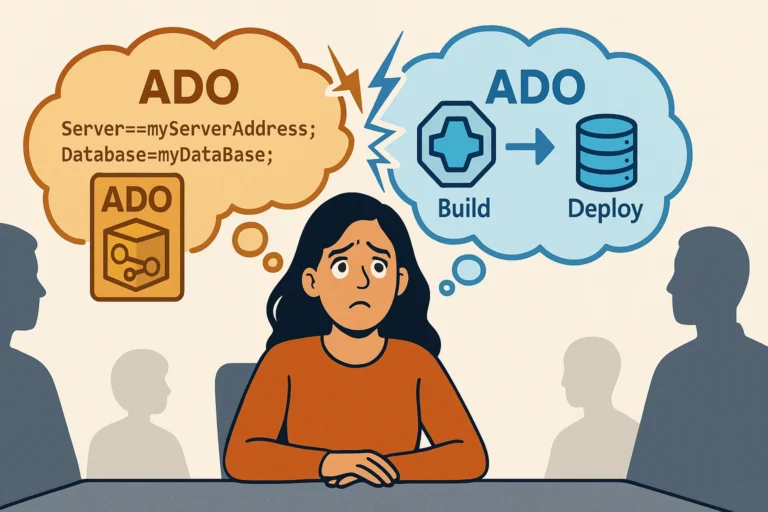
Welcome to the world where Microsoft decided that ADO - an acronym already burned into the collective memory of every developer who touched Windows between 1996 and 2010 - should now mean Azure DevOps.
A Brief History of ADO (the Real One)
ActiveX Data Objects shipped in 1996. It was the standard way to talk to databases from VBScript, classic ASP, VB6, and early COM-based applications. If you wrote data access code on Windows in the late ’90s or early 2000s, you used ADO. Period.
Then came ADO.NET in 2002 with .NET Framework 1.0 - a complete rewrite that shared almost nothing with classic ADO except the name. That was confusing enough. But at least ADO.NET was still a data access technology. The acronym stretched, but it didn’t break.
Enter Azure DevOps (2018)
In September 2018, Microsoft rebranded Visual Studio Team Services (VSTS) - itself a rebrand of Visual Studio Online, which was a rebrand of Team Foundation Service - to Azure DevOps.
And people immediately started abbreviating it to “ADO.”
Now we have two completely unrelated Microsoft technologies sharing the same three letters:
- ADO (1996): A COM-based data access API for connecting to databases
- ADO (2018): A cloud/on-premises platform for source control, CI/CD, work item tracking, and artifact management
One talks to databases. The other builds and deploys software. They have absolutely nothing in common.
The Naming Hall of Shame
Microsoft has a storied history of reusing names in confusing ways. A partial list:
- Azure SQL vs SQL Azure vs Azure SQL Database vs Azure SQL Managed Instance - pick one, any one
- .NET Framework vs .NET Core vs .NET 5/6/7/8/9 - “We’re unifying the brand!” they said, while fracturing the ecosystem
- MSDN meaning a subscription, a website, a magazine, and a developer network - sometimes all at once
- Teams - the chat app, not the feature in Azure DevOps that is also called Teams
But the ADO collision is special because it trips up exactly the people with the most experience. Junior developers who never touched classic ADO have no problem - “ADO” means Azure DevOps to them, full stop. It’s the senior folks, the ones with decades of context, who flinch every time someone says “we need to set up ADO” and their first thought is why are we configuring database connection objects in 2026?
What Should They Have Called It?
The product was already called VSTS, which was fine. Short, unambiguous, not colliding with anything. But Microsoft wanted the Azure brand on everything, so here we are.
If they insisted on “Azure DevOps,” they could have at least discouraged the abbreviation. Or picked a name that didn’t produce a collision. “Azure Dev Platform.” “Azure CI.” “Azure Forge.” Anything.
Instead, we got a naming collision that makes experienced developers feel like they’re having a stroke every time someone says “ADO” in a meeting.
The Pragmatic Response
I just say “Azure DevOps” in full. Every time. Yes, it’s more syllables. No, I don’t care. Clarity beats brevity, especially when brevity produces confusion.
If someone writes “ADO” in a document, I ask which one. Not to be difficult - but because I’ve been writing code since Microsoft Developer Studio, and my brain has 25 years of ADO meaning one very specific thing.
Language matters. Naming matters. And reusing an acronym that an entire generation of developers already has a Pavlovian response to was, frankly, a poor choice.
What’s your least favorite Microsoft naming collision? Come yell about it with me on Bluesky or LinkedIn.