
Agility Comes From the Pipeline, Not the Ceremony
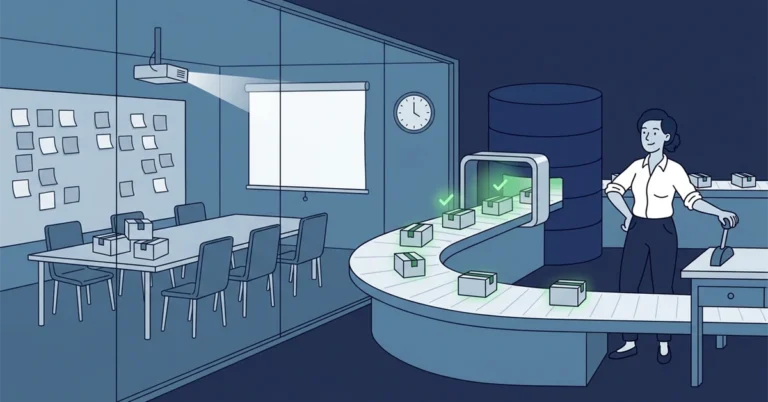
I like CI/CD. I like the agility it gives a team: a small change goes in, the tests run, it deploys, and if it’s wrong it comes back out the same way. What I don’t like is turning every conversation about that work into a ceremony with its own name, its own calendar invite,[1] and its own business vocabulary for what amounts to a few people having a discussion.
This is a hot take, and I know it. I think PI planning is dumb.
This post is part of the Work That Flows: Kanban for DBAs series. The contents page lists every part in order.
What the Manifesto Asked For
The Agile Manifesto has four value statements. The first values “individuals and interactions over processes and tools.” The last values “responding to change over following a plan.”[2] One of its twelve principles says to deliver working software frequently, “from a couple of weeks to a couple of months, with a preference to the shorter timescale.” Another says working software is the primary measure of progress.[3]
None of that mentions a ceremony. The closest the principles get is preferring face-to-face conversation, and a conversation doesn’t need a two-day agenda. Whether a team can deliver working software frequently depends on how the team builds, tests and deploys its software, which is engineering work.
What a Planning Interval Asks For
In the Scaled Agile Framework (SAFe), PI Planning is “typically a 2-day event” for the whole Agile Release Train, held every 8 to 12 weeks. At the end of it, the teams commit to a set of PI objectives.[4] SAFe 6.0 renamed Program Increment to Planning Interval, and renamed the daily standup to Team Sync.[5] I’ll leave it to you whether the standup needed a new name.
Ken Schwaber, one of the manifesto’s signatories, wrote about SAFe in 2013 under the title “unSAFe at any speed.” He quoted the first value back at it and closed with “Keep the values, keep the principles, think for yourself.”[6] He also suggested that organizations adopting it measure cycle time, release cycle and defects to see whether anything improved. Those are delivery numbers, and they’re the ones I’d want to see too.
Ron Jeffries, another signatory, described the SAFe training he attended in 2015: an all-hands planning meeting, with red yarn strung between cards on a whiteboard to show the dependencies between teams. His advice was the opposite: “Eliminate dependencies, don’t document or accommodate them.”[7] In 2018 he wrote that larger-scale “Agile” methods, SAFe among them, “appear actually to recommend imposition of process.”[8]
A Meeting Can Only Find the Problem
Poor planning isn’t going to be fixed by a scrum master who thinks a YAM (Yet Another Meeting) will fix it. A meeting can surface a planning problem. It can tell you that nobody knows how long the data migration will take, or that two teams each assumed the other one owned the index changes. Fixing that takes time spent on the work: a spike, a prototype, a test run against a realistic copy of the data. Then the estimate comes from a measurement instead of a guess.
Two days in a room every quarter can produce a plan with more confidence in it than the people in the room have. SAFe then asks the teams to commit to that plan’s objectives,[4] and once an organization measures people against a commitment, responding to change starts to look like failing to deliver.
Where the DBA Sits
A DBA usually doesn’t belong to any one team. Most teams depend on the database, so a team’s plan can have a line in it that says “DBA” with a number of hours next to it. Add those lines up across every team on the train and the total can be more than one person has in a quarter, before anything goes wrong.
And things go wrong. Some DBA work arrives unplanned: an incident, a blocking chain, a job that ran long, or a vendor patch, none of which existed when anyone planned the quarter. Committing to a quarter of work in advance means committing only to the part you can see. Kanban fits that kind of work better than a fixed sprint does.[9] The board shows what’s in progress, a WIP limit caps how much is in progress at once, and you pull the next most important item when there’s room.
What made my own work more agile was putting database changes under source control and deploying them through a pipeline: migration scripts, SSDT projects with state-based deploys, and scripted deployments that run the same way in every environment. I wrote about that in Putting the Contract Under CI/CD: Database Deployments You Can Trust and Git for SSDT Projects: Where It All Comes Together. Once a schema change is a reviewed commit that deploys the same way to test and production, I can keep each change small and ship them more often. If one is wrong, the fix or the rollback goes out through the same pipeline. That’s what the manifesto principle about frequent delivery describes, and the pipeline is what got me there.
What the Research Measures
DORA (DevOps Research and Assessment) measures software delivery with five metrics: change lead time, deployment frequency, failed deployment recovery time, change fail rate, and deployment rework rate. DORA says its research shows these metrics predict better organizational performance and team well-being. It also reports that speed and stability are correlated for most teams, rather than traded against each other.[10] None of the five measures time spent in planning.
The Fair Part
A short, honest retrospective that ends with one change somebody owns is useful. The manifesto has a principle for it: at regular intervals, the team reflects on how to become more effective and adjusts its behaviour.[3] Getting teams together to find cross-team dependencies is useful too, and SAFe lists that among PI Planning’s benefits.[4] The conversation is fine. The problem starts when it becomes a two-day quarterly event that turns its output into a contract.
Where I Land
When a team has a working deployment pipeline, I find ceremonies add little that a plain conversation wouldn’t. When it doesn’t have one, more ceremonies won’t help, because the team still can’t ship a small change quickly or back it out safely. If I had a quarter’s worth of hours to spend on agility, I’d spend them on automated tests, automated deploys, and a rollback I’ve practised.
I expect some of you disagree, especially if PI planning has worked well for you. Tell me about it on Bluesky or LinkedIn.
Next: Kanban for DBA Work: Pulling Work Instead of Promising a Quarter (available 2026-11-25).
References
- Canadian regions stop turning back the clocks, Microsoft wishes it could - The Register, 2026-11-02. Parts of British Columbia, Alberta and Manitoba stopped seasonal clock changes on 2026-11-01. Existing Outlook calendar entries do not move to the new time zones, so meetings after that date can be an hour off, and only the organizer can correct a shared meeting. ↩
- Manifesto for Agile Software Development - Beck, Schwaber, Jeffries and others, 2001. The four value statements, including “Individuals and interactions over processes and tools” and “Responding to change over following a plan”. ↩
- Principles behind the Agile Manifesto - agilemanifesto.org. The twelve principles, including delivering working software frequently with a preference for the shorter timescale, working software as the primary measure of progress, and regular team reflection on how to become more effective. ↩
- PI Planning - Scaled Agile Framework. Describes PI Planning as typically a two-day event for the entire Agile Release Train every 8-12 weeks, ending in a commitment to PI objectives, and lists identifying dependencies among its benefits. ↩
- What’s New in SAFe 6.0 - Scaled Agile Framework. The terminology tables show Program Increment renamed to Planning Interval, and Daily Standup renamed to Team Sync, in SAFe 6.0. ↩
- unSAFe at any speed - Ken Schwaber, August 6, 2013. A manifesto signatory’s criticism of SAFe, quoting the first manifesto value and recommending that adopters measure cycle time, release cycle, defects and other outcomes. ↩
- Dependencies, Scrum of Scrums, and SAFe - Ron Jeffries, February 8, 2015. Describes the all-hands planning meeting and red-yarn dependency board from his SAFe training, and argues for eliminating dependencies rather than documenting or accommodating them. ↩
- Developers Should Abandon Agile - Ron Jeffries, May 10, 2018. Says larger-scale “Agile” methods, including SAFe, Scaled Scrum and LeSS, appear to recommend imposing process on teams. ↩
- The Kanban Guide - Kanban University. Kanban is a method for managing knowledge work, not a methodology or framework: you make the work visible on a board as it moves through a workflow, limit the amount of work in progress, and pull new work only when there is capacity. It is applied on top of the way a team already works. It grew out of Lean manufacturing and was described for technology work by David J. Anderson in 2010. ↩
- DORA’s software delivery performance metrics - DORA. Defines the five software delivery metrics, states that DORA’s research shows they predict better organizational performance and well-being, and reports that speed and stability are correlated for most teams. ↩