
Acronyms, Collisions, and the Cost of Not Asking
I promised a follow-up to a post about tech vocabulary,[1] and this is it. That one argued that dramatic words and vague words fail the same way: they carry attitude where information should be. I ended on acronyms, said they deserved more room than a paragraph, and left them there.
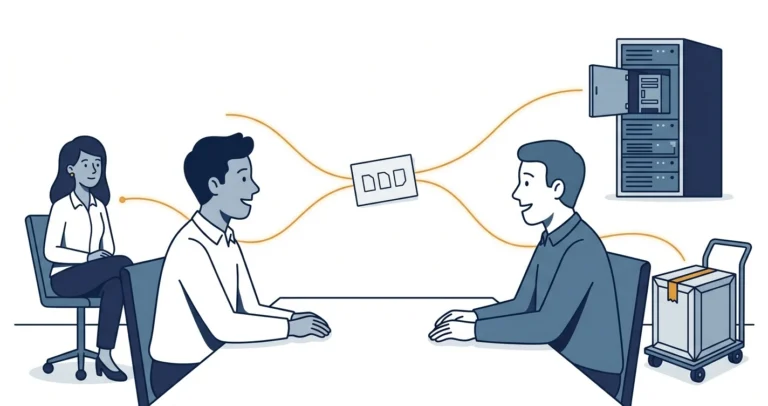
Here is the room.
An acronym is a cache
An acronym takes a long value, “dedicated administrator connection,” and replaces it with a short key, “DAC.” Every time you use the key, you save the cost of the value. Both parties look the expansion up in a codebook they carry in their heads, and the conversation moves faster.
That’s a cache, and like any cache it earns its keep on the hit rate. When both people hold the same codebook, the compression is close to free. “Check the AG before failing over, the RPO depends on it” moves a paragraph of meaning in eleven words, and two DBAs decode it identically. Jargon of that kind is one of the best tools we have, and I’m not here to argue against it.
Three ways the lookup fails
The cache miss. The listener doesn’t hold the expansion. Now they have two options, and both cost something. They can interrupt and ask, which costs a round trip and, in most rooms, a little status. Or they can stay quiet and try to infer it from context, which means they are no longer following the conversation, they’re reverse-engineering it. From the outside, the second option looks identical to comprehension. A room full of nodding people tells you nothing about the hit rate.
The cold cache. A newer colleague doesn’t have a partial codebook, they have an empty one. Every acronym is a miss, misses arrive faster than they can be resolved, and the sensible response is to stop trying and wait for a part they recognize. I had an empty codebook once, and I remember which meetings I spent decoding instead of contributing.
The collision. Same key, two values, and the lookup returns confidently either way. This one fails without any signal at all.
SQL Server has one of the better examples. DAC means “dedicated administrator connection,” the diagnostic back door you use when the instance is too busy to accept a normal login.[2] DAC also means “data-tier application,” the packaged database model that ships as a .dacpac.[3] Both are current. Both are Microsoft’s own terminology, in Microsoft’s own documentation, and the docs put the acronym right in the page titles. A DBA and a release engineer can hold an entire exchange about “the DAC” and walk away with different pictures, and no part of the system will tell them.
That’s a cache collision. In a database we’d call it a wrong result with no error raised, and we’d treat it as more serious than a crash, because a crash is impossible to miss.
DAC isn’t alone. Say “IAM” to me and I think Index Allocation Map, the page that tracks which extents belong to a heap or index.[4] Say it to anyone who works in Azure or AWS and they think Identity and Access Management. Two people can agree that “the IAM is the problem” and be describing unrelated problems. And I’ve written before about ADO,[5] where Microsoft attached a name from 1996 data access to a 2018 DevOps platform and left the rest of us to sort it out from context.
Why the room stays quiet
If the cost of a miss is just one clarifying question, none of this matters much. Asking has a price, though, and the price scales with the room. Admitting a cold cache in front of your manager, or a customer, or the person who will decide whether you’re ready for the senior role, feels like admitting something larger than “I don’t know these three letters.” So the question doesn’t get asked, the miss stays unresolved, and the person adds one more data point to a growing sense that this conversation wasn’t built for them.
Do that often enough and a word gets attached to it. The word is usually “elitist.”
I want to be careful here, because I don’t think that word describes the intent. In my experience people speak in unexpanded acronyms because they’re being efficient with colleagues who have always decoded them, not because they’re guarding a border. But intent isn’t what the listener receives. The listener receives a conversation they can’t follow and a social cost for saying so, and “elitist” is a reasonable name for that experience even when there’s no elitism behind it.
There is research pointing the same direction, though I want to be careful about how far I stretch it. A 2020 experiment with 650 participants found that jargon disrupted how fluently people processed technical material, and that jargon exposure changed how strongly readers identified with the scientific community, which in turn moved their self-reported interest and their sense of how much they had understood.[6] That study looked at science communication with nonexpert audiences, not at database professionals in a planning meeting, so I treat it as a signal rather than proof. But the shape of it matches what I have watched happen in rooms: the cost is not only comprehension. It is whether the person decides this is a room they belong in.
Which means the fix isn’t an attitude adjustment. It’s cache management.
The opposite failure is also real
The correction can overshoot.
Expanding every acronym every time produces sentences like “the Structured Query Language Server Always On Availability Group failover changed the Recovery Point Objective.” That’s not more inclusive, it’s worse. It buries the information under ceremony, and it patronizes the people who did hold the codebook.
The rule isn’t about the letters. It’s about whether the people in the room can decode them. Which means the answer changes with the room, and the skill is noticing which room you’re in.
What I actually do
Here’s the working practice, offered the same way as the substitution list in the last post: not as a moral position, just as things that have made my writing and my meetings work better.
| Situation | What I do |
|---|---|
| Writing a document | Expand on first use. Standard advice, and it costs six words once |
| Sitting in a meeting | Expand when the room changes. A document has a top; a conversation doesn’t, and whoever joined at minute 20 started with an empty codebook |
| Talking across specialties | Say “dedicated admin connection” in full when anyone from the deployment side is present. Same for IAM in any room that touches cloud infrastructure |
| Someone asks me what one means | Answer the question and move on. “Sorry, availability group” costs nothing. “You don’t know what an AG is?” costs a great deal, and the next person watching will not ask |
| I’m the one who doesn’t know | Ask. Often enough to be worth it, someone else in the room needed the same answer and was hoping you would go first |
| Writing for a mixed audience | Assume the budget approver is reading. They usually are, and they’re the one person who cannot ask |
None of this requires abandoning jargon. I still write AG, LSN, and WAL without a second thought when I’m writing for DBAs, because in that room the codebook is warm and the compression is doing what it should.
One caveat on the first line of that table, though. The study I mentioned earlier found that the disruption persisted even when the jargon terms were defined for the reader. If that holds in our context, then expanding on first use helps but does not fully undo the cost, and the stronger move in a genuinely mixed room is to reach for the acronym less often rather than to define it more diligently. Six words once is cheap. Not needing the six words is cheaper.
A miss is a defect, not a discourtesy
The pitch for expanding acronyms usually gets made as a kindness: be considerate, think of the newcomer. That’s true, and it’s also the weakest version of the argument.
The stronger version is that an unresolved miss is a defect in the conversation. You said something, it didn’t arrive, and you probably don’t know that it didn’t. The information you were compressing so efficiently never got delivered, and you’re now proceeding on the assumption that it did. When we find that pattern in a system, we don’t call it impolite. We call it a bug, and we go looking for it.
The people who stop following without saying so are often the ones you most needed to reach: the person new enough to ask the question the rest of you stopped asking years ago, and the person holding the budget. Both of them are sitting there decoding, and neither is likely to tell you.
Got a collision that bit you? The SQL Server list runs longer than DAC and IAM, and I would enjoy hearing yours on Bluesky or LinkedIn, or in the comments below.
References
- The Blast Radius Was Four Rows - the companion piece, on words that carry attitude instead of information. It ends on the acronym problem and promises this post. ↩
- Diagnostic connection for database administrators - Microsoft Learn. The dedicated administrator connection: what it is, its restrictions, and how to establish one when the instance will not accept a normal connection. ↩
- Data-tier applications (DAC) overview - Microsoft Learn. The other DAC: a database model packaged as a dacpac. Note that both pages put the same three letters in the title. ↩
- Pages and extents architecture guide - Microsoft Learn. Defines the Index Allocation Map (IAM) page, along with GAM, SGAM, PFS, BCM, and DCM, which is a fine demonstration of how dense the codebook gets. ↩
- ADO Doesn’t Mean What You Think It Means - the same collision at industry scale: ActiveX Data Objects from 1996, Azure DevOps from 2018, three letters, no relationship. ↩
- Shulman, H. C., Dixon, G. N., Bullock, O. M., & Colón Amill, D. (2020). The Effects of Jargon on Processing Fluency, Self-Perceptions, and Scientific Engagement. Journal of Language and Social Psychology, 39(5-6), 579-597. An experiment with 650 participants finding that jargon disrupted processing fluency even when definitions were supplied, and that it shifted readers’ identification with the science community, which in turn moved their reported interest and perceived understanding. Scope note: the study concerns science communication with nonexpert audiences, not workplace technical conversation. ↩