
Fit the Process to the People: Working With Teams That Never Use a Board
Picture an application support analyst asking the DBA in chat whether the index fix for their slow report is done yet. On the DBA board, the card moved to Done yesterday afternoon. In the ticket system, where that analyst spends the whole day, the ticket still says “Assigned to DBA” with no update for three days. From where the support team sits, nothing has moved.
This post is part of the Work That Flows: Kanban for DBAs series. The contents page lists every part in order.
The previous part argued that one system should drive the DBA’s work. This part covers the teams that system doesn’t fit. Application support, a service desk, an operations group: some teams never use a Kanban board, and they have no reason to start. Their queue, their priorities and their performance numbers all live in the incident and ticket system. My opinion is that the DBA’s single-driver rule applies to the DBA. It’s not a reason to move anyone else onto a board.
Fit the Process to the People
I’d rather fit the process I use to the people I work with than make them fit it. The Agile Manifesto puts “individuals and interactions over processes and tools” first among its values.[1] One of its principles says to build projects around motivated individuals and give them the environment and support they need.[2] A support team that works well in its ticket system already has that environment. Asking them to work in the DBA board so that the DBA process looks tidy gets the priority backwards.
Kanban University says much the same. It describes Kanban as a method applied on top of an existing way of working, not a replacement for it, and its first change management principle is “Start with what you do now.”[3] For the support team, what they do now is work in the ticket system, and the DBA board can start from there without asking them to change anything.
The Ticket System Is Their Front Door
For a team like this, the ticket system is how work reaches me. They open a ticket, assign it to the DBA queue, and expect the answer to come back through the same ticket. Kanban University’s glossary defines a customer as whoever makes the request and accepts the delivery, and it says a requesting team inside the same organization can count as an internal customer.[4] The support team is my customer, and their ticket is the request.
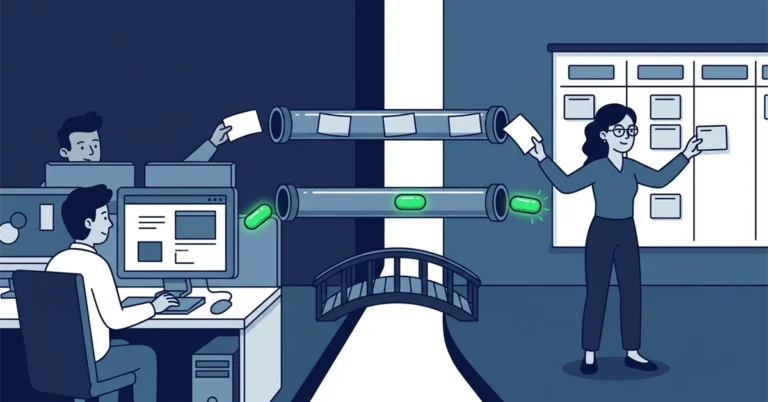
The DBA board is a pull system. When a ticket lands in the DBA queue, it gets a card with the ticket number in the title and a link back to the ticket. The card waits in the backlog until there’s room to start it, then I pull it. The support team can see the card on the board, but they never have to open the board to get their answer.
Keeping the ticket and the card connected is the DBA’s job. The DBA work runs on the board, so the DBA side pays for the link between the two systems.
Send Status Back Where They Already Look
The scenario at the top happens when status only flows one way. The fix is to make each move on the board show up on the ticket. Keep the mapping short:
- Card pulled into In Progress: a ticket note saying I’ve started, and the ticket status changes to In Progress if the ticket system has one.
- Card blocked: a ticket note saying what I’m waiting for and from whom. If I’m waiting on the support team, the ticket goes back to them, so the wait shows up in their queue.
- Card in Review or Deploying: a ticket note with the change reference and when I expect it to reach production.
- Card Done: I resolve the ticket, with a short note on what changed.
The previous part recommended integrating the ticket system with the board where the tools allow it. Until that integration exists, do it by hand. A one-line note takes less than a minute, and a manual note beats a stale ticket while someone builds the integration. If the volume justifies it, a script can read the board and write to the ticket system for you. The next part in this series (available 2026-11-29) includes an example that reads card history through the Jira REST API, which is a starting point for that kind of script.
Don’t Make Them Update Two Tools
The other approach comes up often: ask the support analyst to also create a card on the DBA board, or move it when they’ve tested the fix. I think that’s a mistake. Two copies of the same status drift apart, and the person who doesn’t use the board every day is usually the one who misses an update. The support analyst also gets nothing from the second entry. Their own reporting comes from the ticket system.
If you need something from them, ask for it on the ticket. If they add information to the ticket, copy what you need onto the card. Double entry still happens, but it happens on the DBA side, where you can see whether it’s keeping up.
Agree Service Levels That Map to Lanes
Most ticket systems put a priority on every ticket, and organizations often measure support teams against a resolution target for each priority. The DBA board has to respect those targets, or the support team is the one who misses them.
A class of service is a set of policies for how a team treats a type of work, and it often sets a service level expectation. The common archetypes are expedite, fixed date, standard and intangible.[4] Expedite items can go through even when the work-in-progress limit is full, and other work waits longer as a result.[3] That maps onto ticket priorities fairly directly. Anything in production goes in an expedite lane. A request tied to a release date goes in a fixed-date lane. Ordinary requests go in the standard lane.
Agree on the mapping with the support team instead of handing it to them. The Kanban Guide says everyone involved, including customers, should agree on policies jointly.[3] The glossary describes a service level expectation as a forecast based on past delivery, using the example of 85% of items delivered within 10 days.[4] With a few months of history per lane, the board’s data can give the support team a number like that instead of a guess.
Measure From the Requester’s Side
The board measures lead time from the moment someone pulls a card. That number makes the DBA look faster than they are, because it leaves out the days the ticket sat in the queue before anyone started it, which are days the support team counted.
Kanban University separates the two. Customer lead time runs from receiving the customer’s request to delivering on it. System lead time starts at the commitment point, the point where someone decides to start the work.[4] On the DBA board, the commitment point is when a card leaves the backlog. The support team experiences something closer to customer lead time, measured in their own system. Measure from when the ticket lands in the DBA queue to when it’s resolved, and check whether their resolution target starts its clock earlier than that, at the moment someone opened the ticket. Let the tools record both timestamps, and report the ticket system’s number to the support team.
Google’s SRE book makes a similar point about services. Client-side latency is often the measure that matters more to users than what the server records, and most metrics are better read as distributions than as averages.[5] So look at the 85th percentile of ticket resolution time per lane, which lines up with the glossary’s service level expectation example, rather than the average. The gap between customer lead time and the board’s lead time shows how long work waits before anyone starts it. If that gap is large, the fix usually starts on the DBA side: a lower intake, a clearer priority, or a conversation about capacity.
Where I Land
I work from the board, and it shows me where work is stuck. The teams I serve can see it, but they keep the ticket system as their only tool. Connecting the two, keeping the ticket current and measuring the result from their side are the DBA’s responsibility, because the DBA work is what runs on the board. The opener of this series, Agility Comes From the Pipeline, Not the Ceremony, argued that a team becomes agile by delivering, and that ceremonies add little to that. I hold the board to the same standard. It helps me deliver, and nobody else has to update it for that to work.
If you run a board alongside a team that never touches one, I’d like to hear how you keep the two in step. Find me on Bluesky or LinkedIn.
Previous: One System Should Drive the Work, Not Several Driving You. Next: Setting Up Jira as a Lean Kanban Board for DBA Work (available 2026-11-29).
References
- Manifesto for Agile Software Development - Beck, Schwaber, Jeffries and others, 2001. The first of the four value statements is “Individuals and interactions over processes and tools”. ↩
- Principles behind the Agile Manifesto - agilemanifesto.org. Includes the principle “Build projects around motivated individuals. Give them the environment and support they need, and trust them to get the job done.” ↩
- The Kanban Guide - Kanban University. Describes Kanban as a method applied to an existing way of working rather than a replacement for it, lists “Start with what you do now” as the first change management principle, says policies should be agreed jointly by everyone involved including customers, and explains that expedite items may pass through when the WIP limit is full while other work takes longer. ↩
- The Kanban Method Glossary - Kanban University. Defines customer (including internal customers), class of service and its four archetypes, service level expectation with the 85% within 10 days example, commitment point, customer lead time and system lead time. ↩
- Service Level Objectives - Google, Site Reliability Engineering. Notes that client-side latency is often the more user-relevant metric, and that most metrics are better thought of as distributions than averages. ↩